
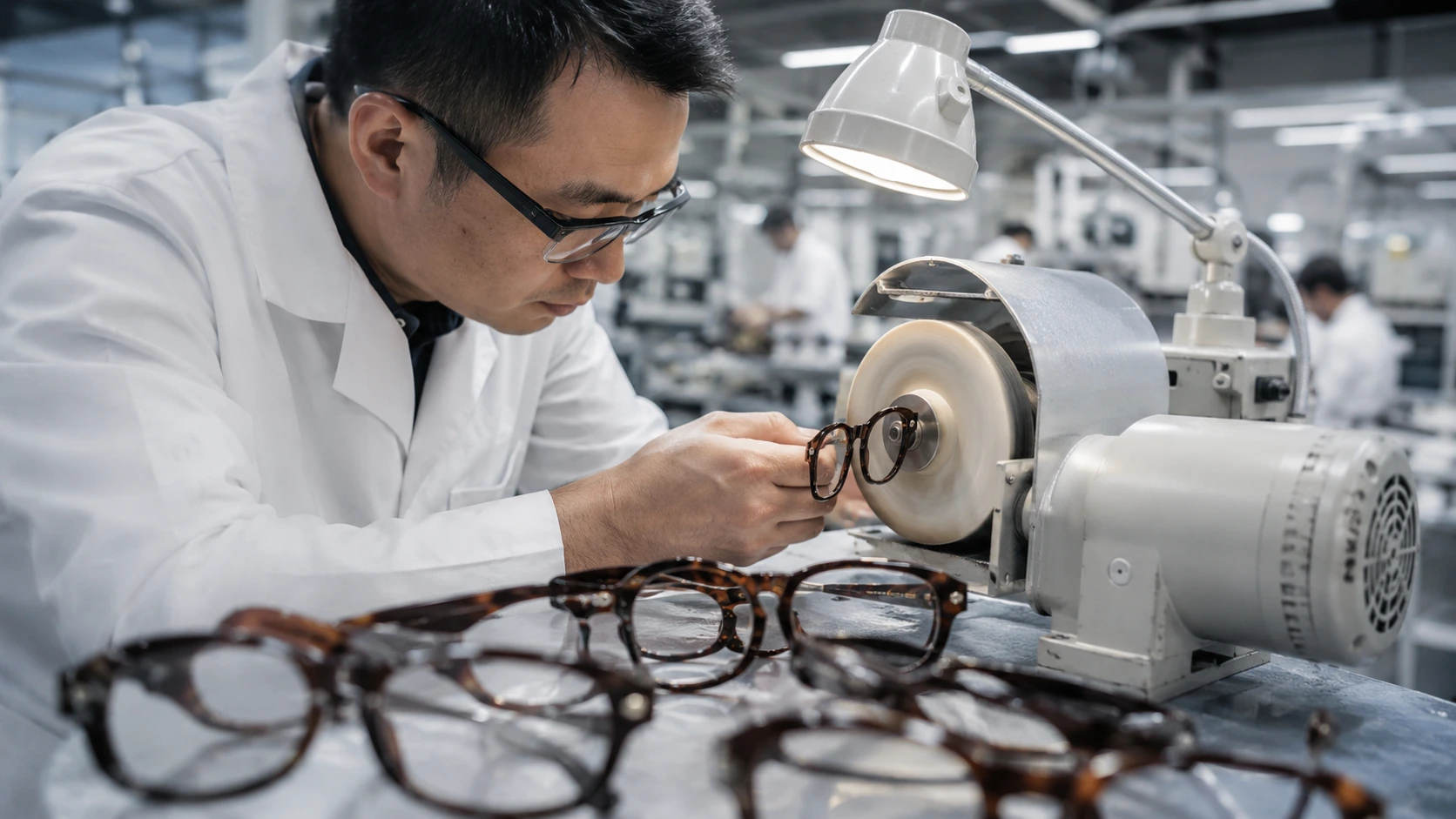
En ce qui concerne lunettes en acétateLa différence entre une paire de lunettes haut de gamme et une paire moyenne réside dans ces détails invisibles. Le véritable secret d'un confort durable et d'une allure impeccable tient à la maîtrise des techniques de fabrication, du traitement des feuilles d'acétate au polissage minutieux. Choisir un fabricant réputé, aux contrôles qualité rigoureux, permet de transformer un modèle basique en lunettes à la fois élégantes et robustes.
L'acétate est un matériau exceptionnel car il allie robustesse et facilité de mise en forme. Fabriqué à partir de matières naturelles comme les chutes de coton et les fibres de bois, et non de plastiques dérivés du pétrole, il est plus écologique et plus doux pour la peau. Les fabricants l'utilisent en couches successives pour obtenir des couleurs vives et durables. De plus, il se plie à la chaleur sans se déformer, permettant ainsi aux opticiens d'ajuster parfaitement les montures à chaque personne.
L'acétate règne en maître dans la fabrication haut de gamme grâce à sa capacité à être façonné avec précision et lissé. Les artisans travaillent les bords avec minutie, les angles nets et les courbes douces tout en conservant une épaisseur constante. Les créateurs repoussent les limites des styles classiques ou contemporains, sans jamais compromettre la robustesse ni le confort. Vous remarquerez peut-être comment une monture de qualité épouse parfaitement votre visage, offrant une sensation de légèreté et de maintien optimal tout au long de la journée.
Une fois les feuilles d'acétate brutes arrivées, les lunettes L'usine intervient pour garantir la qualité. Chaque étape est minutieusement contrôlée, de la découpe des feuilles à l'assemblage final. Des experts vérifient l'uniformité des côtés du cadre, alignent correctement les charnières et s'assurent que le brillant corresponde aux exigences de la marque.
Les ateliers équipés d'outils modernes garantissent des formes et des perçages d'une précision accrue, réduisant ainsi les défauts de forme et d'aspect. Cependant, les machines seules ne suffisent pas. L'inspection humaine reste indispensable. Un ouvrier attentif repère les minuscules bulles d'air ou les légères variations de couleur qui pourraient échapper à la technologie. Les meilleures usines allient machines et savoir-faire manuel, assurant ainsi l'homogénéité des lots, quelle que soit leur taille. Nombreux sont ceux qui constatent que cette combinaison fait toute la différence au quotidien.
La fabrication de lunettes en acétate massif commence bien avant l'assemblage. Tout débute par la sélection de feuilles d'acétate résistantes.
Une feuille d'acétate fine présente une épaisseur uniforme. De petites variations peuvent compromettre le fraisage ou le cintrage ultérieurs. Sa densité constante évite également les points faibles susceptibles de provoquer des fissures avec le temps.
Même la couleur est un signe de qualité. Les feuilles haut de gamme présentent des teintes riches, sans lignes ni bulles. Pliez-en une délicatement à la main : elle se courbe facilement sans se fissurer ni laisser de traces blanches. Ces caractéristiques déterminent la facilité avec laquelle les cadres se prêtent à la découpe et au lissage. Imaginez passer vos doigts sur un échantillon : sa souplesse et sa douceur témoignent de sa robustesse.
| Propriété | Feuille de haute qualité | Feuille de mauvaise qualité |
| Épaisseur | Même à la surface | Zones irrégulières |
| Couleur | Sonorité profonde et homogène | Décoloré ou strié |
| Flexibilité | Courbes sans blanchiment | Fragile lorsqu'elle est façonnée |
Ces caractéristiques physiques influent directement sur le comportement des cadres lors de la découpe et du polissage.

L'acétate bon marché présente immédiatement des défauts en atelier. Des irrégularités de teinte apparaissent après la découpe, surtout aux jonctions des couches. Certains matériaux bas de gamme contiennent des impuretés qui laissent de minuscules marques après le lissage.
Il se casse souvent facilement. Si on le chauffe pour le plier, il risque de se fendre ou de s'affaisser. Plus tard, les couches détachées peuvent se décoller. Cela nuit à son aspect et à sa solidité. On peut le constater sur les cadres qui commencent à s'écailler après quelques mois d'utilisation.
Les usines établies s'associent à des fournisseurs fiables spécialisés dans l'acétate de cellulose de qualité optique. Ces fournisseurs fournissent des documents attestant de leur conformité aux normes internationales telles que la norme ISO 12870 relative aux matériaux pour lunettes.
Avant le lancement des grandes productions, les usines contrôlent des échantillons pour vérifier la couleur, la fermeté et la souplesse. Elles effectuent des tests à chaud, comme pour le moulage. Certaines conservent de petits échantillons de chaque lot. Ces échantillons servent à ajuster les étapes suivantes et à garantir l'uniformité de la production. Ainsi, vous obtenez des montures parfaitement adaptées à votre vue à chaque fois.
Le façonnage s'achève, puis vient le polissage. Cette étape clé détermine l'éclat et le toucher du cadre.
Le polissage transforme les aspérités en zones lisses qui captent la lumière de façon optimale. Un travail bien fait. cadre en acétate Elle brille comme un miroir. Elle donne de la profondeur au regard et glisse en douceur sous les doigts. Les finitions de mauvaise qualité paraissent ternes ou rêches près des oreilles ou du nez.
Ce toucher précis compte pour bien plus que le style. Il évite les frottements au niveau des montures. Dans le monde professionnel, le polissage témoigne d'un véritable savoir-faire. Il distingue les marques haut de gamme des marques bon marché. Imaginez enfiler une paire de chaussures confortables dès le premier essayage, sans aucun réglage nécessaire.
Les usines choisissent entre méthodes manuelles et machines en fonction du modèle et du volume de production :
Ils combinent ces éléments en fonction du style requis et des délais de livraison souhaités par les clients. Les employés s'adaptent en temps réel pour atteindre le résultat souhaité.
De minuscules glissements apparaissent sous une forte lumière :
Ces éléments indiquent un travail bâclé ou des contrôles négligés en fin de chaîne dans l'usine de lunettes.
Pour choisir un bon partenaire, il faut se baser sur des preuves concrètes, et pas seulement sur les coûts. Il est essentiel d'observer de près ses compétences et sa fiabilité.
Interrogez-les sur les contrôles à chaque étape, du contrôle des matériaux à l'emballage. Les nouvelles machines de découpe CNC, utilisées par des opérateurs qualifiés, surpassent les anciens outils manuels. Elles offrent des résultats plus précis. La tenue d'un registre des réglages d'outillage témoigne de leur souci de la régularité du travail sur le long terme. Nombre d'acheteurs négligent cet aspect, pourtant essentiel pour garantir la conformité de vos commandes.
Si possible, rendez-vous sur place. Observez les lignes de production en fonctionnement. La façon dont le personnel manipule les feuilles témoigne de leur souci de la qualité. Impossible de vous y rendre ? Demandez des échantillons de différentes productions, et pas seulement un échantillon test. Cela permet de vérifier leur tenue et leur brillance, même après plusieurs essais.
Testez soigneusement ces échantillons. Examinez attentivement l'ajustement des charnières et passez vos mains à l'intérieur des branches. Ces points sont essentiels pour un confort optimal tout au long de la journée, mais sont souvent négligés.
Faites équipe avec une équipe expérimentée comme SUSONVous bénéficiez ainsi de bien plus qu'une simple production. Nos designers suivent les tendances mondiales en matière de lunettes. Nous adaptons les options à votre marque, des impressions spéciales sur acétate aux effets de brillance dégradée.
Des échanges ouverts permettent de s'assurer que les spécifications sont conformes avant le lancement de la production. Cela évite des modifications coûteuses par la suite. Nous envoyons des mises à jour régulières. Vous restez informé des étapes et pouvez apporter des modifications si nécessaire en cours de route.
Recherchez une couleur d'une profondeur uniforme, sans stries ni bulles ; l'acétate de cellulose véritable est légèrement chaud au toucher, contrairement aux alternatives en plastique.
Le délaminage résulte généralement d'une mauvaise adhérence entre les couches lors de la production des feuilles ou d'une exposition excessive à la chaleur lors des étapes de mise en forme.
Le polissage manuel offre un contrôle plus précis sur les formes complexes, mais il est plus long ; le polissage à la machine garantit rapidité et uniformité pour les formes plus simples.
Les usines professionnelles testent chaque lot avant la découpe afin de vérifier la densité, l'homogénéité de la couleur et la flexibilité sous les conditions de chaleur utilisées lors du moulage.
Les partenariats directs améliorent la communication concernant les attentes en matière de conception tout en garantissant un contrôle qualité transparent à toutes les étapes de la fabrication.
Q6 : Quels sont quelques matériaux en acétate réputés pour leur qualité garantie ?