
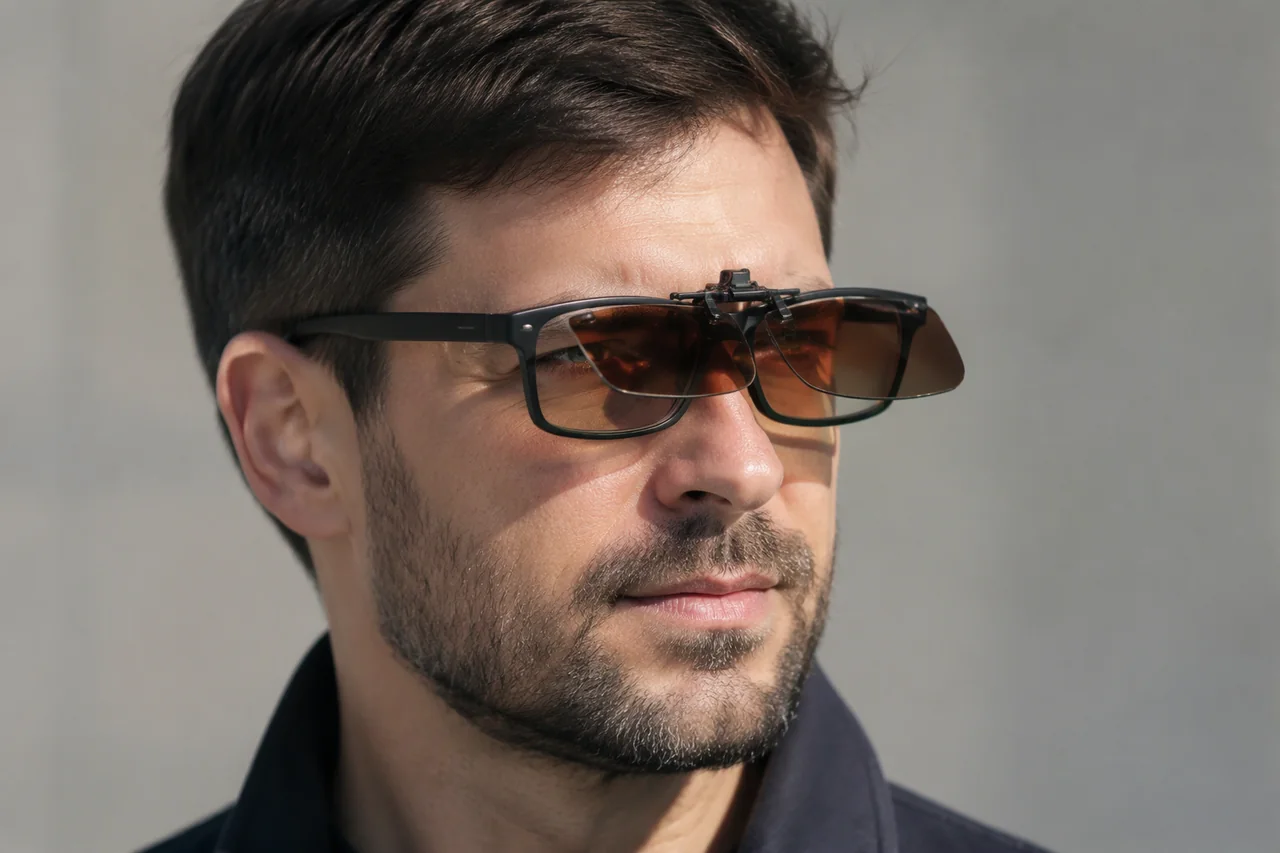
A clip-on is a supplementary sun lens carried in a light frame that is held by spring clips or small magnets in front of the lenses of a prescription spectacle, so that the wearer has sun protection without a second pair of spectacles. The light frame should be designed to be worn on the outside of the prescription frame. In most cases the frame and sun lenses will be in one piece, but there are also detachable frames, and magnetic clip-ons with the lenses in separate cases.
A complete clip-on set has three parts:
The front for a clip-on is usually injection-moulded. The support frame or carrier may be of metal or plastic but must be very light in weight, so that the prescription frame may be worn comfortably.
For a brand or a wholesaler the gains are these:
Looking to expand your eyewear collection? Explore SUSON’s clip-on eyewear range and discover wholesale options for your next product launch.
Five points decide whether a clip-on suits a frame:

The size across should allow for the nose pads (metal frames) and the nose area (plastic frames). The bottom of the frame should cut off the prescription lenses not below the pupils, or at any rate not below the bottoms of the prescription lenses.
Spring clips are made of thin-gauge stainless steel and have flat spring arms. They clamp over the upper part or entire top rim of the prescription frame. A clip should be designed for the lightest possible pressure that will still keep the clip-ons on.
The lens is usually tinted green or gray. A colourless top and tinted bottom are sold as a daytime driving combination.
Metal frames can be of nickel silver, monel, titanium, or stainless steel. The cross section of the frame can differ from pattern to pattern, but it is usually flat with a slight round-edge bend down at the nose bridge. The front can be all metal or half metal and half cellulose acetate.
The three common frame materials work like this:
A wide range of front shapes is available to the customer. The shape is usually rectangular, but there are also square, oval and round clip-ons.
A cellulose acetate clip-on is cut in the special cutters that are available for the work. The unit for a clip-on is the front unit, plus clips or magnets, and the lens for each eye. Clip-ons are available in a wide range of styles, but it is difficult to find a pattern that suits all prescription frames.
It is essential to make a first sample and check the fit on the customer’s own glasses before leaving the workshop. By this method the top of the clip-on lens can be cut to fit at the right height, the nose spread can be adjusted to fit the customer’s nose, and the customer can try the clip-ons on his or her own frame.
Make a careful inspection for nicks and marks, burrs, paint or dirt, cracks, and for the correct fit of the lens in the edging. The flat spring arms of the clip should be straight.
If the customer wants a metal frame, the weight of metal is of vital importance. The correct sizes are checked against the frame drawing or specification and a check made that the clips or magnets are the correct size and fit the correct parts of the prescription frame.
Settle these four points before the work starts:
The frame should be packed in a bag of thin cloth which will fit the shape of the front. If a clip-on is made to order, the work is delivered after trial-fitting.
It is very important to the exporter to know the model, style and pattern of the clip-on, and the tint of the lens or lenses. The number of pairs of clip-ons is also essential, and if the order is mixed, the breakdown in size pairs must be given.
State these particulars in the order:
Searching for a reliable clip-on glasses manufacturer? Contacta con SUSON to discuss your product specifications, request samples, and receive a customized wholesale quotation.
For a wholesale or custom clip-on programme the essentials are these:
Ready to develop your own clip-on collection? Partner with SUSON for flexible clip-on eyewear Soluciones OEM y ODM. Share your ideas with our team and let’s bring your next eyewear project to life.
The clip-on front is pressed onto the top of the frame’s bridge and rim tops. The amount of engagement depends on the height of the frame bridge and rim.
The protective effect of a tinted front depends on the light direction and the wearer’s head position.
Have these particulars ready so the quotation can be exact:
The engagement of the clip-on front on the frame is a fragile fit, and in daily use it weakens in the following ways:
A yellow-tinted front is a good fit for a driver with a tired eye in weak light, but the tint should be thin if the driver must read signs and instruments through it. The light that reaches the eye depends on the tint of the front, and on the head position.
Before the order is placed, check these points: